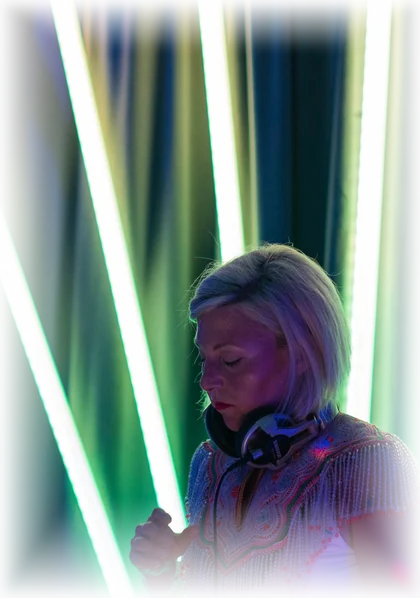
"When it comes to emotional architecture in musical journeys, Daniela is unmatched."
Daniela holds over 30 years of NYC dance music history in her blood and bones. Shaped by the golden era of the city's nightlife — the floors of Limelight, Twilo, Sound Factory, and David Mancuso's legendary Loft — she carries that lineage into every set she plays. A classically-trained pianist of 20 years, she learned to DJ on vinyl at Satellite Records, then the largest independent dance music store in the US, before years in Berlin and Milan deepened her connection to European club culture.
In 2020, she founded Deep Playa NYC, producing 75+ events spanning massive outdoor raves, sold-out venue nights in Brooklyn, festivals, campouts, workshops, and retreats — including the largest overnight outdoor rave in NYC history in July 2023, with 300 to 1,200 attendees at venues including Elsewhere, Brooklyn Monarch, and The Meadows. From 2022–2025 she served as Music Director and stage designer for CAMP Festival, headlining each year and designing sound stages for Love Burn and regional Burns. She has played Elements Festival, multiple Burning Man art cars, and in 2025 was commissioned by the Mütter Museum in Philadelphia for a four-hour immersive Halloween set — designed around the four Medieval humors and the four seasons — working alongside the production team in a creative direction role for the event.
Her sets defy genre. Cinematic, emotionally-driven, and always intentional — from emotionally hypnotic tribal depth to French house, big room techno, or an unexpected classic that creates collective release. Every journey she crafts becomes a ceremony of remembrance. Per Astra is where that architecture meets the cosmos.
Music as a channel
While Daniela is known for her emotionally powerful techno and house, she is not bound by any genre — because she doesn’t work in genres. She works in frequencies.
A set might open in ambient stillness, work its way through sultry downtempo, drift into trip hop and cinematic depth, then dissolve into early 1900s folk, a traditional Indian raga, or the pulse of Brazilian samba — and back again. Whatever she is channeling in that moment, that becomes the music.
The only throughline is intention. Every sound placed for a reason. Every transition earned.